OnboardRail
40-screen React Native mobile application. Full frontend with Firebase (auth, Firestore). Offline and online sync for reliable data access and real-time updates. Delivered end-to-end from wireframes to deployment.
Case study summary
- Client type
- Mobile application client
- Industry
- Mobile operations
- Duration
- TODO: Confirm project dates and duration
- My role
- Wireframes, frontend and Firebase integration
- Team size
- TODO: Confirm team size and collaborators
- Stack
- React Native, Firebase, Firestore, Figma
- Platforms
- React Native mobile application
Challenge
Translate a multi-screen brief into consistent navigation, authentication and data access with usable offline behavior.
Approach
Review flows in Figma before implementation, reuse screen patterns and integrate Firebase services around the accepted user journeys.
Architecture

Key features
- Figma wireframes
- React Native screens
- Firebase Authentication
- Firestore offline persistence
Results and measurement
The delivered scope is described in this case study. Numeric performance or business results require a measurement source and owner approval.
TODO: Add the verified baseline, final value, measurement period and evidence link. API-count claim: TODO — verify before publication.
Client feedback
TODO: Add an approved client quote for this project, with the client's attribution and source. No invented testimonial is displayed.
Want something similar? Explore this service →Project at a glance
My contribution and the engineering challenge
- My role
- Wireframes, mobile frontend and Firebase integration
- The problem
- Turn a multi-screen brief into a consistent mobile journey with authentication and reliable data access.
What I delivered
- Figma wireframes and React Native screens
- Firebase Authentication integration
- Firestore data access and offline persistence
How the parts connect
- STEP 1Wireframes and user journey
- STEP 2React Native application
- STEP 3Firebase Auth and Firestore
Simplified implementation overview.
A key design decision
Resolve navigation and user flows during wireframing, then reuse implementation patterns across the application.
TODO: Add permission-approved, sanitized product screenshots. Concept art is not shown as product evidence.
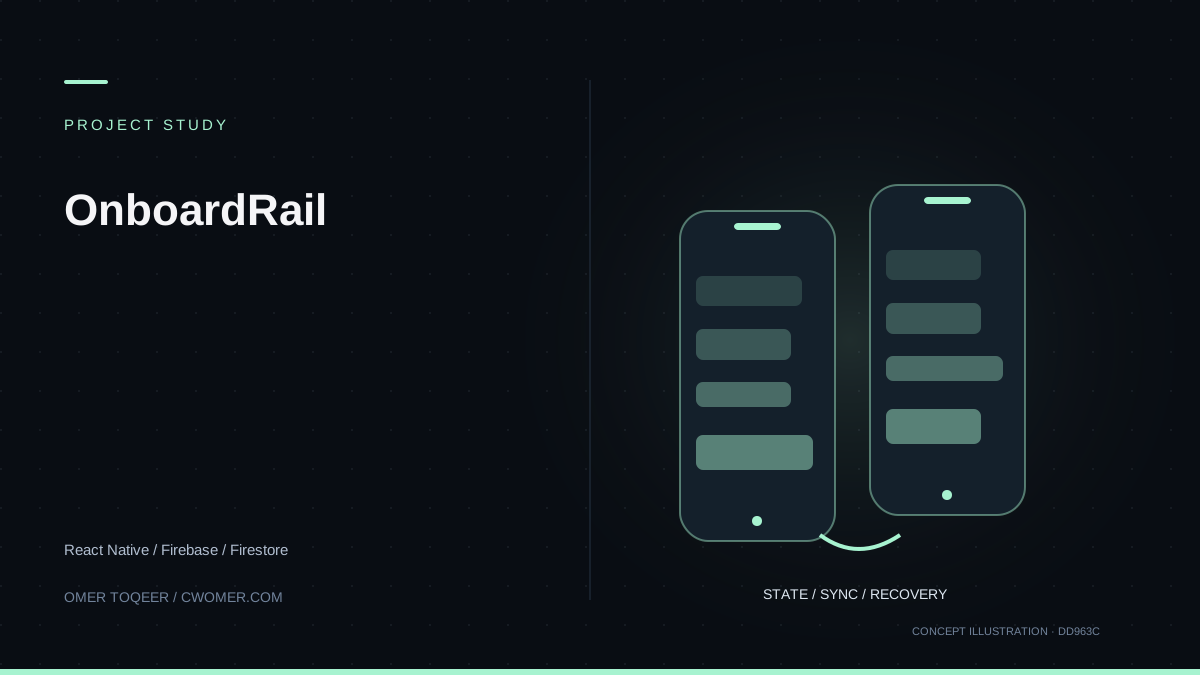
Technical concept illustration. The case study below describes the project implementation.
Overview
OnboardRail is a 40-screen React Native application built end-to-end — from Figma wireframes through Firebase-backed implementation to deployment. It was owned solo across the entire pipeline: design, architecture, frontend, and backend integration.
Why This Was Hard
A 40-screen app is a design and state-management problem as much as an engineering one — keeping navigation, data flow, and offline behavior consistent across that many screens without the codebase turning into a maze of one-off patterns required disciplined component reuse from day one.
What I Built
- Complete 40-screen user journey from onboarding through every core feature
- Firebase Authentication — secure email/password login flows
- Firestore integration — real-time data with offline persistence built in
- Offline and online sync — reliable data access with conflict handling when the app comes back online
- Figma wireframes designed before a single screen was built, validating flows with the client early
- Consistent state management patterns reused across all 40 screens to keep the codebase maintainable at scale
Tech Stack
- Framework: React Native
- Backend: Firebase (Auth, Firestore)
- Design: Figma wireframes
- Platforms: iOS, Android
Collaboration
Working solo across the full pipeline — Figma wireframes, architecture, frontend, and Firebase integration — meant the client feedback loop had to happen at the wireframe stage, not after code was written. Screens were walked through and approved in batches before implementation began, so by the time development reached a given flow, the direction was already validated and rework stayed minimal across all 40 screens.
Outcome / Impact
Delivered the project end to end — design, architecture, implementation, and deployment — owning the full pipeline from first wireframe to shipped app, as reflected in direct client feedback on the finished product.
Related work
QuickThread — Chat App
5-screen chatting application for iOS and Android. Quick Figma wireframes and full React Native implementation with real-time messaging.
TallyPocket — Offline Business Ledger
Offline-first React Native app for local businesses to manage expenses, items, and money transfers. Google Drive sync for data backup and cross-device consistency. Built for local client record-keeping.
TongueLoop
React Native app for speech and translation: speech-to-text, text-to-speech, and translation for foreign language learners. Cross-platform for iOS and Android.
Interested in similar work?
Review my services and how we can define a useful first milestone.
Discuss similar work